
Why Grip Strength Matters More Than You Think in CrossFit and HYROX
By WE.FIT
You’re four rounds into a long chipper. Deadlifts feel fine. Your lungs are holding up. Then your hands open. Not because your back is tired. Not because your legs gave out. Your forearms just quit.
Sound familiar? You’re not alone. Grip is the weak link in almost every athlete’s chain — and hardly anyone trains it on purpose.
The Invisible Bottleneck
Think about how many movements in CrossFit and HYROX depend on your hands holding on to something. Pull-ups, toes-to-bar, deadlifts, cleans, kettlebell swings, farmer’s carries, barbell cycling. That’s most of your workout right there. And in every single one, grip is the silent limiter.
In HYROX it’s even more obvious. The farmer’s carry — 200 meters with 2x24 kg (men) or 2x16 kg (women) — is pure grip. Your legs can walk all day, but your forearms are screaming after 100 meters. Then there’s the sled push and pull, where you need to maintain a solid hold on the handles while generating maximum force. Rowing for 1,000 meters with fatigued hands. Even wall balls — holding that 9 or 6 kg ball for 100 reps takes more grip than you’d expect.
When grip goes, everything goes. You can’t hold the bar, so you break more often. You break more often, so your times get slower. Your times get slower, so you get frustrated. And the whole time, the fix was right there — you just never trained it.
Why Your Forearms Fail First
Here’s the thing: your forearm muscles are small. Really small compared to your quads, glutes, and back. They fatigue fast and recover slowly during a workout. Your deadlift might be limited to 100 kg not because your posterior chain can’t handle more, but because your fingers can’t hold on.
And most of us make it worse. We rush through warm-ups, skip accessory work, and — this is the big one — reach for lifting straps the moment things get uncomfortable. Straps have their place. Heavy rowing sets, max-effort deadlifts, sure. But if you strap up for every workout, you’re building a house on a foundation you never bothered to pour.
Five Exercises That Actually Work
The good news: grip responds quickly to training. A few minutes at the end of your workout, two or three times a week, and you’ll notice a difference within weeks.
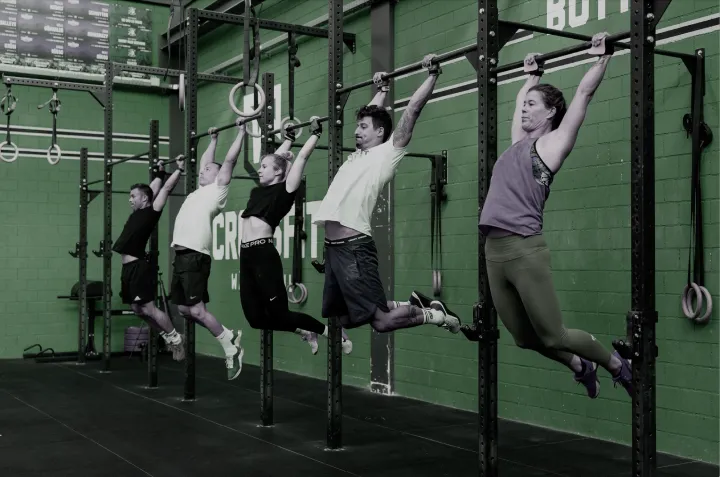
Dead hangs. Jump up to the pull-up bar and just hang there. That’s it. Start with whatever you can manage — 15 seconds is fine. Build toward 60 seconds or more. Want to make it harder? Use a thick bar, hang from one arm, or add a slight swing to challenge your fingers to readjust. Dead hangs also decompress your spine, so your back will thank you.
Farmer’s carries. Pick up the heaviest dumbbells or kettlebells you can hold and walk. 40 meters, turn around, come back. Keep your shoulders packed and your core tight. This trains grip under load while you’re moving — exactly what HYROX demands. If your gym has a trap bar, even better.
Towel hangs. Throw a towel over the pull-up bar and grip the ends. Hang. This shifts the challenge from your fingers to your entire hand and wrist. It’s brutal, and it works. Once you can hang from a towel for 30 seconds, try doing pull-ups on it.
Plate pinches. Grab two weight plates (smooth side out) and pinch them together with one hand. Hold for time. Start light — two 5 kg plates is harder than you think. This targets your thumb and finger pinch strength, which matters for gripping thick handles and odd objects.
Wrist curls. Sit on a bench, forearm resting on your thigh, and curl a light dumbbell with just your wrist. Do both directions — palm up and palm down. 15-20 reps, two or three sets. Boring? Yes. Effective? Absolutely. These build the endurance your forearms need for long workouts.
When and How to Train It
Don’t skip your WOD to do wrist curls. Grip work goes at the end of your session, when your hands are already fatigued — that’s when it counts most. Two or three times a week is enough. Pick two exercises, spend five minutes on them, and move on.
You can also weave it into warm-ups. A 30-second dead hang between mobility drills takes no extra time and primes your hands for what’s coming.
The key is consistency. Grip strength builds slowly but holds well. Once you’ve got it, it doesn’t disappear overnight like your engine does when you skip a week of cardio.
Beyond the Gym
Here’s a bonus you don’t hear coaches talk about enough: grip strength is one of the best predictors of overall health and longevity. Seriously — there are studies on this. Strong hands correlate with lower rates of heart disease and longer life spans.
And on a more practical level — carrying all the grocery bags in one trip, opening stubborn jars, moving furniture, playing with your kids without your hands cramping. Grip strength makes daily life easier in ways you don’t notice until you have it.
The Straps Conversation
We’re not anti-straps. If you’re pulling heavy and your grip is the only thing stopping you from training your back or legs at the right intensity, strap up. The goal is to develop your body, not to let one weak link hold everything else back.
But be honest with yourself. If you need straps for every set of deadlifts at moderate weight, that’s a signal. Your grip is undertrained, and the straps are hiding it. Use them strategically, not as a crutch.
Start This Week
Next time you’re at WE.FIT — whether that’s our Box in Wädenswil or Meilen — finish your workout and hang from the bar. Just hang. Time it. Write it down. Do it again next session and try to beat it.
That’s literally all it takes to start. No special equipment. No complicated program. Just you and the bar and a willingness to hold on a little longer.
Your coaches can help you build grip work into your routine. Ask them. They’ve seen what happens when athletes commit to it for a few weeks — suddenly those sets of toes-to-bar don’t require three breaks, and the farmer’s carry at your next HYROX feels like a different movement entirely.
Ready to train with us? Send us a message on WhatsApp and book your free trial class. We’ll take it from there.