
The First Time You See the Whiteboard: How to Read a WOD Without Panicking
By WE.FIT
You walk into the gym. There’s a whiteboard near the entrance. On it, someone has written what looks like a coded message — letters, numbers, abbreviations, maybe a time cap. People around you are nodding like it all makes perfect sense. You’re standing there thinking: what am I looking at?
That’s normal. Every single person in that room had the exact same moment on their first day. The whiteboard is not a test. It’s just the plan for today’s workout. And once you know how to read it, it’s actually pretty simple.
What Is a WOD?
WOD stands for Workout of the Day. It’s exactly what it sounds like — the workout your coach has programmed for that session. Every day is different. Some days are heavy lifting. Some days are fast and cardio-heavy. Some days make you question your life choices around minute seven. All of them make you better.
The WOD is usually written on a whiteboard at the front of the gym, sometimes on a screen. It tells you what movements you’ll do, how many reps, how heavy, and what format you’re working in.
The Main Formats
This is where it starts to look intimidating — but it’s really just a handful of structures. Once you know these, you can read any WOD.
AMRAP (As Many Rounds As Possible) — You get a set time (say, 12 minutes) and a list of movements. You cycle through the list as many times as you can before time runs out. No rush to finish. Just keep moving.
EMOM (Every Minute On the Minute) — At the start of each minute, you perform a set number of reps. Whatever time is left in that minute is your rest. When the next minute starts, you go again. The faster you work, the more rest you get.
For Time — Complete the workout as fast as possible. There’s usually a time cap (say, 15 minutes), which means if you don’t finish, that’s fine — your score is however far you got.
Rounds For Time — Similar to For Time, but the workout is structured as a set number of rounds. “5 Rounds For Time” means you complete the list of movements five times through, as fast as you can.
Chipper — A long list of movements you work through once from top to bottom. No repeating. Just chip away at it. These tend to be longer and test your mental game as much as your body.
The Abbreviation Cheat Sheet
Here’s where the whiteboard starts to look like alphabet soup. These abbreviations show up constantly, and they’re worth knowing.
- Rx — “As prescribed.” The workout exactly as written, with the suggested weights and movements. This is the standard, not the expectation. More on this below.
- WOD — Workout of the Day
- AMRAP — As Many Rounds As Possible
- EMOM — Every Minute On the Minute
- C&J — Clean and Jerk
- S2OH — Shoulder to Overhead (any way you get it there — push press, push jerk, split jerk)
- T2B — Toes to Bar
- C2B — Chest to Bar (pull-ups where your chest touches the bar)
- DU — Double Unders (the jump rope passes under your feet twice per jump)
- MU — Muscle Ups (bar or ring)
- HSPU — Handstand Push-Up
- KB — Kettlebell
- DB — Dumbbell
- BB — Barbell
You don’t need to memorise these. After a few weeks, they stick naturally. And your coach will always explain what everything means before you start.
Rx vs Scaled — the Part That Matters Most
On the whiteboard, you’ll usually see two columns: Rx and Scaled. Rx is the prescribed version — the full movements and weights as written. Scaled is an adjusted version designed to give you the same workout stimulus at a level that suits you.
Here’s the thing most beginners don’t realise: scaling isn’t failing. Scaling is training smart. If the WOD calls for 60kg deadlifts and your form breaks down at 40kg, doing 40kg with good technique is the better workout. You’re still getting stronger. You’re still doing the work. You’re just doing it at the right level for where you are today.
Almost everyone scales when they start. Many experienced athletes scale regularly too, depending on the workout. The coaches at WE.FIT will help you pick the right weight and movement options every single time. That’s literally their job.
Let’s Read a WOD Together
Here’s a sample workout you might see on the board:
AMRAP 15 10 KB Swings (24/16kg) 12 T2B 200m Run
Here’s what that means, piece by piece:
- AMRAP 15 — You have 15 minutes. Do as many rounds as you can.
- 10 KB Swings (24/16kg) — 10 kettlebell swings. The first number (24kg) is the Rx men’s weight. The second (16kg) is the Rx women’s weight. Your coach will help you pick the right one for you.
- 12 T2B — 12 toes-to-bar. Hang from the pull-up bar and bring your toes up to touch it. Scaled version? Hanging knee raises work great.
- 200m Run — Run 200 metres. If running isn’t your thing, there’s usually a row or bike option.
That’s it. Three movements, 15 minutes, keep going. Your score is the number of full rounds plus any extra reps you completed.
See? Not so scary.
What Happens in the Room
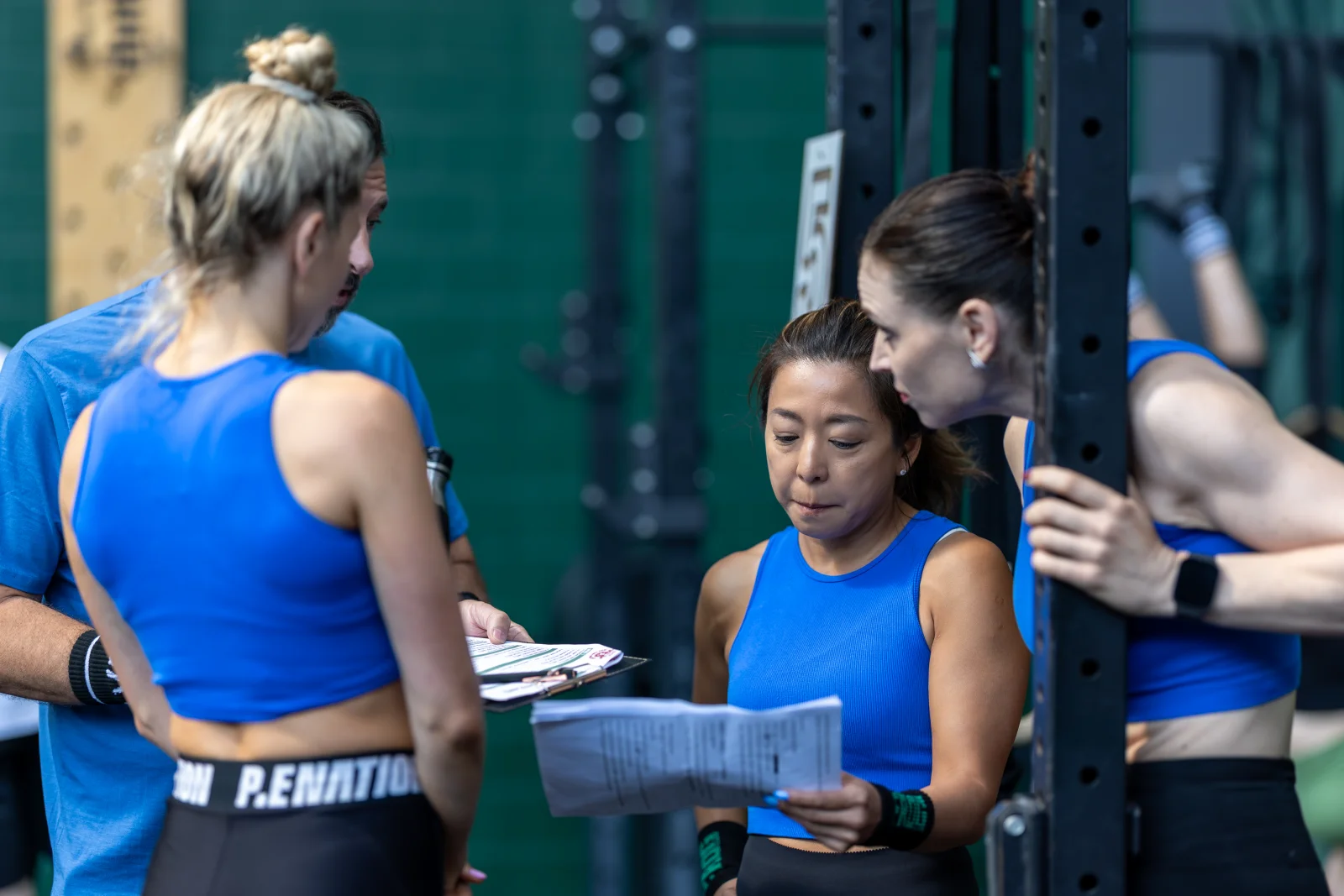
Here’s what the whiteboard doesn’t tell you: before every class, the coach walks through the entire workout. They explain every movement. They demonstrate it. They tell you what to scale and how. They check your form during the warm-up. And during the workout itself, they’re watching, cueing, and helping.
Nobody expects you to decode the whiteboard solo on day one. Or day ten. The board is a reference point, not a pop quiz. The real information comes from your coach, standing right in front of you, making sure you know exactly what you’re doing before the clock starts.
At WE.FIT — whether you’re at our Wädenswil or Meilen box on the shores of Lake Zurich — every class starts with a thorough brief. You’ll always know what’s coming. And if you forget mid-workout, just look at the board. That’s what it’s there for.
You’ll Pick It Up Faster Than You Think
After your first few classes, the whiteboard starts making sense. You’ll know what AMRAP means without thinking. You’ll spot the difference between For Time and EMOM at a glance. The abbreviations that looked like gibberish will become second nature.
And honestly, that moment when you walk in, glance at the board, and immediately understand what’s ahead? It feels great. It means you belong. Because you do.
Ready to try your first WOD? We offer 2 free trial classes — no experience needed, no pressure, just show up. Our coaches handle the rest.